6.9 - Safe Disposal Requirements
Module: Safety Leak Detection Shipping and Safe Disposal
Regulatory verification date: August 10, 2026
Primary authority: Current 40 CFR Part 82, Subpart F, especially §§ 82.155 and 82.156, together with current EPA stationary-refrigeration safe-disposal guidance
Additional current-rule context: 40 CFR Part 84, Subpart C requirements for disposable cylinders containing regulated HFC substances, including requirements scheduled to take effect January 1, 2028
Course role: Explains refrigerant recovery before appliance disposal, the difference between equipment dismantled on-site and equipment entering the waste stream intact, final-processor verification duties, disposal-chain responsibilities, disposable refrigerant-cylinder issues, and safe-disposal recordkeeping
Learning Objectives
After completing this section, a student should be able to:
- Explain why refrigerant must be properly recovered before covered refrigeration and air-conditioning equipment is disposed of.
- Distinguish equipment that is normally dismantled on-site from equipment that normally enters the waste stream with the refrigerant circuit intact.
- Explain the refrigerant-recovery requirement for central air-conditioning systems, retail food refrigeration, chillers, and industrial-process refrigeration before disposal.
- Explain the special safe-disposal framework for small appliances, MVACs, and MVAC-like appliances.
- Identify the responsibilities of the final processor / final disposer.
- Explain when a signed verification statement is required and identify the information that must appear in the statement.
- Explain when a contract can be used instead of an individual signed statement.
- Explain why an EPA disposal sticker by itself does not satisfy the current federal verification requirement.
- Explain the special procedure when all refrigerant has already leaked from an appliance before it reaches the final processor.
- Explain which persons recovering refrigerant from small appliances, MVACs, and MVAC-like appliances for disposal are exempt from the ordinary Section 608 technician-certification requirement.
- Identify the three-year recordkeeping responsibilities of final processors and technicians in the applicable disposal situations.
- Explain why a disposable refrigerant cylinder is not the same thing as an appliance and identify the upcoming January 1, 2028 federal requirements for disposable cylinders containing regulated HFC substances.
- Apply a disposal-chain decision process to common EPA 608 examination scenarios.
Introduction
Disposal is the last stage of a refrigeration or air-conditioning appliance’s life, but it is not the point at which refrigerant-management responsibilities disappear.
The basic rule is:
Appliance reaches end of life
→ refrigerant must be properly managed
→ refrigerant may not simply be released because the equipment is being discarded
Current EPA safe-disposal rules recognize two important disposal paths.
Path 1 — Equipment Normally Dismantled On-Site
Examples include:
- Central residential air-conditioning systems.
- Retail food refrigeration equipment.
- Chillers.
- Industrial-process refrigeration equipment.
These systems are normally disconnected, opened, or dismantled at the installation site.
For these appliances:
recover refrigerant according to normal Section 608 service-practice requirements
→ then dismantle / remove / dispose
Path 2 — Equipment Normally Entering the Waste Stream Intact
Examples include:
- Household refrigerators.
- Household freezers.
- Window air conditioners.
- Other qualifying small appliances.
- MVACs.
- MVAC-like appliances.
These appliances can arrive at:
- Scrap-metal facilities.
- Recycling facilities.
- Landfills.
- Other final-processing facilities.
with the refrigerant circuit still physically intact.
For these appliances, the final processor has special responsibilities to ensure that refrigerant is properly recovered before final disposal.
The distinction is fundamental:
Field-dismantled equipment
→ normal service-practice recovery before disposal
Intact waste-stream equipment
→ special final-processor safe-disposal verification framework
A technician preparing for the EPA Section 608 examination should understand both paths.
Key Concepts
1. Disposal Does Not Cancel the Recovery Requirement
A common incorrect idea is:
The appliance is trash
→ refrigerant no longer matters
That is wrong.
Current Section 608 requirements are intended to reduce refrigerant emissions during:
- Maintenance.
- Service.
- Repair.
- Disposal.
For appliances subject to the normal service-practice evacuation rule:
before disposal
→ recover / evacuate refrigerant to the applicable required level
For small appliances, MVACs, and MVAC-like appliances:
special safe-disposal recovery and verification requirements apply
2. The Disposal Path Depends on How the Appliance Reaches the Waste Stream
The most useful first question is:
Will the appliance normally be dismantled on-site
or
will it enter the waste stream with the refrigerant circuit intact?
This determines which disposal framework should be considered first.
3. Equipment Dismantled On-Site Uses Normal Service-Practice Recovery
EPA’s current safe-disposal guidance identifies examples such as:
- Retail food refrigeration.
- Central residential air conditioning.
- Chillers.
- Industrial-process refrigeration.
These appliances must have refrigerant recovered according to the applicable EPA service-practice requirements before disposal.
For appliances subject to 40 CFR §82.156(a):
before opening or disposing
→ recover refrigerant, including liquid refrigerant
→ to the applicable Table 1 level
→ using certified recovery / recycling equipment
unless a specific exception applies.
The current Table 1 requirements were developed in:
4. “Dismantled On-Site” Is About the Disposal Process
The phrase does not mean that every part of the appliance must be physically reduced to scrap at the installation site.
The important idea is that the refrigerant circuit is normally handled and opened as part of field removal or dismantling rather than being sent intact to a final waste processor.
A residential split-system example is:
Outdoor condensing unit + indoor evaporator
→ technician recovers refrigerant at job site
→ system is disconnected
→ components enter scrap / disposal stream
The scrap facility should not be expected to perform the original field recovery from a charged split system after the refrigerant lines have already been cut.
5. Small Appliances Use a Separate Recovery Requirement
Before opening or disposing of a small appliance, current §82.156(b) requires refrigerant recovery using certified recovery/recycling equipment according to one of the applicable conditions.
For recovery equipment manufactured before November 15, 1993:
recover 80%
For recovery equipment manufactured on or after November 15, 1993:
compressor functional
→ recover 90%
compressor nonfunctional
→ recover 80%
Alternative:
evacuate small appliance
→ 4 in. Hg vacuum
These are the same Type I recovery concepts introduced earlier in Module 5 and developed in detail in Module 7.
6. MVACs and MVAC-Like Appliances Have Separate Recovery Provisions
Current §82.156(c) and (d) contain separate disposal-recovery requirements for:
- MVAC-like appliances.
- MVACs.
The current rule allows the applicable subpart B evacuation procedure or a reduction of system pressure to or below:
102 mm Hg vacuum
for disposal-recovery purposes.
Do not substitute the small-appliance:
90% / 80% / 4 in. Hg vacuum
requirements for an MVAC or MVAC-like appliance unless the actual rule for the equipment supports that procedure.
7. The Final Processor Has the Last Disposal Responsibility
For a:
- Small appliance.
- MVAC.
- MVAC-like appliance.
the final processor is the person taking the final step in the disposal process.
Examples include:
- Scrap recycler.
- Scrap-metal processor.
- Landfill operator.
EPA’s public guidance often describes this party as the:
final person in the disposal chain
or:
final disposer
The regulation uses the term:
final processor
For this course:
Final processor and final disposer refer to the final disposal-stage entity; use “final processor” when referring to the regulatory text.
8. The Final Processor Has Two Main Options
Current §82.155(b) gives the final processor two basic choices.
Option 1 — Recover Remaining Refrigerant
Appliance arrives with refrigerant
→ final processor recovers remaining refrigerant
→ according to applicable disposal-recovery requirements
Option 2 — Verify That Refrigerant Was Already Recovered
Appliance arrives without refrigerant
→ final processor verifies proper prior recovery
→ using signed statement or qualifying contract
The final processor cannot simply assume that an empty-looking appliance was properly evacuated.
9. A Signed Verification Statement Must Contain Specific Information
If the final processor relies on a signed statement, the statement must include:
- Name of the person who recovered the refrigerant.
- Address of the person who recovered the refrigerant.
- Date the refrigerant was recovered.
EPA’s current public guidance states that the final disposer obtains the signed statement from the person supplying or dropping off the appliance.
The verification function is:
Who recovered it?
Where is that person located?
When was it recovered?
10. EPA Does Not Require or Accept a Sticker Alone as the Verification
A persistent exam trap involves the idea that a technician places a sticker on an appliance and the final disposer is then automatically compliant.
EPA’s current guidance states:
A sticker by itself is not the federal verification method required by the current safe-disposal rule.
The final processor still needs the required:
- Signed statement, or
- Qualifying contract.
Therefore:
"Refrigerant removed" sticker
→ may be useful operational information
→ does not replace required signed statement / contract
Do not confuse a facility’s internal sticker system with the federal verification requirement.
11. A Contract Can Be Used for Regular Commercial Suppliers
The rule allows a signed contract between the supplier and final processor.
The contract must state that the supplier will either:
- Properly recover remaining refrigerant before delivery, or
- Verify that the refrigerant had been properly recovered before the supplier received the appliance.
EPA explains that this contract method is intended to streamline transactions with:
regular commercial suppliers
It is not intended as the routine verification method for infrequent suppliers such as:
- Individual consumers.
- Occasional peddlers.
- One-time drop-offs.
For those situations, the signed-statement approach is the more appropriate current EPA framework.
12. The Final Processor Must Notify Suppliers
Current §82.155(b)(2)(ii) requires the final processor to notify appliance suppliers that refrigerant must be properly recovered before delivery.
Notification can use methods such as:
- Signs.
- Letters.
- Other equivalent means.
A useful disposal-facility sign concept is:
REFRIGERANT-CONTAINING APPLIANCES
Refrigerant must be properly recovered before delivery
or recovery will be performed by the final processor.
The exact facility sign is not federally prescribed in one required format.
13. A False Statement Cannot Be Accepted Knowingly
Current §82.155 makes it a violation for a final processor to accept a signed statement or contract when the recipient:
knew
or
had reason to know
that the statement or contract was false.
Therefore:
paperwork exists
≠
automatic compliance
if the final processor has obvious evidence that the paperwork is not credible.
14. “All Refrigerant Leaked Out” Has a Specific Meaning
Sometimes an appliance arrives with no recoverable refrigerant because the refrigerant escaped before delivery.
Current §82.155 allows a special signed statement when all refrigerant had leaked out and recovery is not possible.
The rule explains that “leaked out” means refrigerant escaped because of events such as:
- System failure.
- Accident.
- Other unavoidable occurrence.
It does not include deliberate or negligent acts intended to empty the system.
For example:
coil failed accidentally and refrigerant escaped
→ leaked-out statement may apply
but:
person cuts refrigerant line to "empty" appliance
→ not an acceptable leaked-out condition
A deliberate cut is not converted into compliant recovery merely by signing a statement afterward.
Disposal-Chain Responsibilities
1. Equipment Owner or Operator
The owner/operator should:
- Identify the appliance and refrigerant.
- Arrange proper recovery before field dismantling when applicable.
- Use an appropriately certified technician when certification is required.
- Avoid cutting or opening charged refrigerant circuits.
- Maintain required equipment/service records when applicable.
- Provide truthful information to the recovery technician and disposal chain.
For intact small-appliance disposal, the owner may deliver the appliance to a facility that performs final recovery.
The owner should not intentionally vent refrigerant to make disposal easier.
2. Technician or Person Recovering Refrigerant
The person performing recovery should:
- Use the appropriate recovery equipment.
- Follow the required recovery level.
- Prevent cross-contamination.
- Use suitable recovery cylinders.
- Record disposal-recovery information when the applicable recordkeeping rule requires it.
- Provide accurate information for any required disposal verification.
3. Supplier / Transporter
The person or business delivering appliances to the final processor should:
- Not deliberately damage the refrigerant circuit.
- Comply with the final processor’s recovery/verification requirements.
- Provide truthful signed statements when prior recovery is being documented.
- Operate under an appropriate commercial supplier contract when that method is used.
- Follow applicable transportation requirements.
4. Scrap Processor / Final Processor
The final processor must:
- Ensure remaining refrigerant is recovered, or
- Verify proper prior recovery through an allowed signed statement or contract.
- Notify suppliers that refrigerant must be recovered.
- Reject or properly handle noncompliant appliances.
- Avoid accepting paperwork known or reasonably suspected to be false.
- Keep applicable signed statements/contracts on site for three years.
5. Reclaimer or Destruction Facility
Recovered refrigerant may later be:
- Reclaimed.
- Destroyed.
- Managed as another authorized refrigerant stream.
The final disposition depends on:
- Refrigerant identity.
- Contamination.
- Ownership.
- Intended future use.
- Current refrigerant-management rules.
Reclamation and transfer to a new owner were covered in Section 5.1 - Recover Recycle and Reclaim.
Technician Certification During Disposal
1. General Rule
EPA’s current technician guidance states that Section 608 certification is required for a person who disposes of an appliance when that activity could reasonably be expected to violate the refrigerant circuit.
2. Disposal Exceptions
The current technician definition contains disposal exceptions for:
- Small appliances.
- MVACs.
- MVAC-like appliances.
Therefore:
person recovers refrigerant from small appliance for disposal
→ Section 608 technician certification not required solely for that disposal activity
However:
The recovery requirements still apply.
The exemption is from the technician-certification requirement for the disposal activity.
It is not an exemption from proper refrigerant recovery.
3. Recovery Equipment Still Must Meet the Required Standards
EPA’s current safe-disposal guidance specifically states that persons recovering refrigerant from small appliances, MVACs, and MVAC-like appliances for disposal do not need to be certified technicians, but the recovery equipment must meet the same performance standards applicable to servicing.
Therefore:
No technician certification required for this disposal path
≠
any improvised recovery device may be used
4. Do Not Extend the Disposal Exception to Ordinary Service
A person may be allowed to recover refrigerant from a small appliance for disposal without Section 608 technician certification.
That does not mean the same person may perform ordinary:
- Maintenance.
- Service.
- Repair.
that could violate the refrigerant circuit without the appropriate certification.
The purpose of the activity matters.
Recordkeeping Requirements
1. Final-Processor Records for Small Appliances, MVACs, and MVAC-Like Appliances
Current §82.155(c) requires the final processor to keep copies of signed statements or contracts used to verify prior refrigerant recovery.
Retention period:
3 years
The records must be kept:
on site
and may be:
- Hard copy.
- Electronic.
This requirement belongs to the:
final processor
not automatically to every homeowner who discards a refrigerator.
2. Technician Disposal Records for More Than 5 lb and Less Than 50 lb
Current §82.156(a)(3) establishes a separate recordkeeping requirement for technicians evacuating refrigerant from appliances with a full charge of:
more than 5 lb
and:
less than 50 lb
for purposes of disposal.
Retention period:
3 years
The required records include:
- Company name.
- Location of the appliance.
- Date of recovery.
- Type of refrigerant recovered for each appliance.
- Total quantity of refrigerant, by type, recovered from all disposed appliances in each calendar month.
- Quantity of refrigerant, by type, transferred for reclamation and/or destruction.
- Person to whom the refrigerant was transferred.
- Date of transfer.
3. Do Not Round the Regulatory Threshold Into a Different Rule
The eCFR wording is:
full charge > 5 lb
and
full charge < 50 lb
For precise regulatory questions, do not silently change this to:
5 lb through 50 lb inclusive
The exact regulatory language controls.
4. The Two Three-Year Rules Are Different
Do not confuse:
Final Processor
small appliance / MVAC / MVAC-like
→ signed statements / contracts
→ keep 3 years
with:
Technician
appliance full charge >5 and <50 lb
→ disposal recovery records
→ keep 3 years
Both use a three-year period, but:
- Different parties keep the records.
- Different appliances are involved.
- Different information is recorded.
Verification Statement Details
1. Normal Prior-Recovery Statement
A current compliant statement must support the conclusion that refrigerant was properly recovered before delivery.
At minimum, the regulatory statement includes:
Name of person who recovered refrigerant
+
Address of person who recovered refrigerant
+
Date refrigerant was recovered
A practical facility form may also include:
- Supplier name.
- Appliance description.
- Quantity of appliances.
- Refrigerant if known.
- Signature/date of person supplying the statement.
Do not omit the required regulatory information simply because a facility’s internal form contains other data.
2. Contract Alternative
A regular commercial supplier and final processor can use a contract stating that the supplier will:
recover remaining refrigerant properly before delivery
or:
verify that refrigerant had already been properly recovered
before supplier received the appliance
The contract should be maintained under the current final-processor recordkeeping requirement.
3. Leaked-Out Statement
If all refrigerant escaped before delivery because of an allowable accidental/system-failure situation:
final processor
→ obtains signed statement
→ refrigerant leaked out before delivery
→ recovery is not possible
Do not use this statement when:
- Refrigerant was intentionally vented.
- Lines were cut to release refrigerant.
- Someone negligently destroyed the refrigerant circuit to avoid recovery.
Safe-Disposal Decision Procedure
Use the following sequence for EPA 608-style questions.
Step 1 — Identify the Equipment
Is it:
- Central air-conditioning equipment?
- Retail food refrigeration?
- Chiller?
- Industrial-process refrigeration?
- Small appliance?
- MVAC?
- MVAC-like appliance?
- Another covered appliance?
Step 2 — Determine the Disposal Path
Ask:
Normally dismantled on-site?
If yes:
use normal Section 608 recovery / evacuation requirements
→ before dismantling / disposal
If no, and it normally enters the waste stream intact:
evaluate special final-processor safe-disposal requirements
Step 3 — Determine Whether Refrigerant Remains
For a small appliance, MVAC, or MVAC-like appliance reaching the final processor:
Refrigerant remains?
If yes:
final processor must recover it
or otherwise arrange compliant recovery before final disposal
If no because proper recovery already occurred:
verify with signed statement or qualifying contract
If no because it leaked out accidentally:
obtain leaked-out signed statement
Step 4 — Verify the Recovery Equipment and Procedure
The person recovering refrigerant must use the equipment and recovery endpoint applicable to the appliance.
Step 5 — Determine Certification Requirement
Ask whether:
- The disposal activity is exempt for small appliance/MVAC/MVAC-like equipment.
- Ordinary Section 608 certification applies to the person violating the circuit.
Do not confuse:
certification exception
with:
recovery exception
Step 6 — Determine Recordkeeping
Ask whether:
- Final processor relied on signed statement/contract.
- Technician recovered refrigerant for disposal from an appliance with full charge >5 and <50 lb.
- Another current program-specific record applies.
Step 7 — Dispose of Refrigerant and Equipment Through the Proper Channels
Recovered refrigerant should be:
- Reused by the same owner where allowed and technically appropriate.
- Sent for reclamation.
- Sent for destruction.
- Otherwise managed according to the applicable current requirements.
The appliance may then enter the appropriate:
- Recycling.
- Scrap.
- Disposal.
process after refrigerant obligations are satisfied.
Examples
Example 1 — Residential Split-System Replacement
A contractor replaces a residential split system.
The old system will be disconnected and removed from the site.
Correct sequence:
recover refrigerant to applicable service-practice endpoint
→ verify required recovery
→ disconnect refrigerant lines
→ remove components
→ send equipment for scrap / disposal
The contractor should not:
cut line
→ allow refrigerant to escape
→ send empty equipment to scrap yard
Example 2 — Household Refrigerator Delivered to Scrap Recycler
A homeowner brings an intact refrigerator to a scrap recycler.
The recycler is the final processor.
If the refrigerator still contains refrigerant:
final processor
→ recover remaining refrigerant
→ before final disposal
If a qualified recovery person already removed the refrigerant:
final processor
→ obtain required signed verification
A sticker alone does not replace the statement.
Example 3 — Commercial Appliance Supplier With Regular Contract
A commercial appliance collector routinely supplies recovered appliances to the same scrap processor.
The parties may use a qualifying signed contract under the safe-disposal rule.
The contract can specify that the supplier will:
- Recover refrigerant before delivery, or
- Verify that refrigerant was properly recovered before the supplier received the appliances.
This commercial-contract route reduces repetitive individual paperwork.
Example 4 — Refrigerator With Catastrophic Coil Failure
A household refrigerator suffers an accidental refrigerant-circuit failure and loses its entire charge before disposal.
At the final processor:
no refrigerant remains
+
recovery impossible
The processor must obtain the applicable signed statement that the refrigerant leaked out before delivery.
The leaked-out provision is not permission for someone to deliberately puncture the appliance.
Example 5 — Technician Disposes of Residential Split System With 8-lb Full Charge
The technician recovers the refrigerant for disposal.
The appliance full charge is:
8 lb
This falls within:
>5 lb and <50 lb
Therefore the technician’s three-year disposal-recovery recordkeeping requirement applies.
Example 6 — Exactly 50-lb Full Charge
An appliance has a full charge of exactly:
50 lb
The specific technician disposal recordkeeping provision at §82.156(a)(3) is written for:
more than 5
and
less than 50 lb
Therefore do not automatically apply that particular subsection to exactly 50 lb.
Other current recordkeeping requirements may apply depending on:
- Refrigerant.
- Appliance.
- Other federal programs.
Disposable Refrigerant Cylinders
A disposable refrigerant cylinder is not the same thing as a refrigeration appliance.
This distinction matters because the appliance safe-disposal rules in:
40 CFR §82.155
are not simply copied onto a refrigerant supply cylinder.
1. Disposable Cylinders Are Nonrefillable
Many one-way refrigerant cylinders are built to a nonrefillable transportation specification such as DOT Specification 39.
Current DOT Specification 39 describes these as:
non-reusable
(non-refillable)
Do not refill a disposable cylinder as though it were a recovery cylinder.
Use a refillable recovery cylinder designed and authorized for recovered refrigerant.
2. “Empty” Can Still Contain a Refrigerant Heel
After normal charging operations, a disposable cylinder can contain:
- Refrigerant vapor.
- Residual liquid.
- A refrigerant “heel.”
Therefore:
no useful liquid comes out
≠
zero refrigerant remaining
The cylinder should be handled according to the current refrigerant, cylinder, supplier, employer, transportation, and waste-management procedures.
3. Current EPA Part 84 Rule Has a Future January 1, 2028 Effective Date
A significant current regulatory development appears in:
40 CFR §84.116
under the AIM Act HFC management program.
The main disposable-cylinder heel-removal requirement is scheduled to take effect January 1, 2028.
It is therefore important to distinguish:
rule exists in current CFR
from:
compliance date has already arrived
The January 1, 2028 requirement is future, not yet the current operating deadline.
4. Which Disposable Cylinders Are Covered by the 2028 Requirement?
Beginning January 1, 2028, §84.116 applies when all three conditions are met:
- The disposable cylinder contains one or more regulated substances under Part 84.
- The cylinder was used in servicing, repair, or installation of refrigerant-containing equipment or fire-suppression equipment.
- The person does not intend to use the disposable cylinder in future servicing, repair, or installation.
5. 2028 Processing Path
Beginning January 1, 2028, covered disposable cylinders generally must be sent to an appropriate entity capable of handling the remaining heel, such as:
- EPA-certified reclaimer.
- Fire-suppressant recycler for applicable fire-suppression use.
- Final processor capable of removing the heel.
- Refrigerant supplier capable of removing the heel.
The regulated substance removed from qualifying cylinder heels must then be managed through the required reclamation/recycling pathway.
6. Certified-Technician Alternative Under §84.116
The current rule contains an alternative pathway under which a covered disposable cylinder may be discarded to a final processor when:
- A certified technician removes the heel.
- The used disposable cylinder is evacuated to:
15 in. Hg vacuum
- The technician provides the required signed certification statement.
- The statement includes the technician’s name and address and the date the cylinder was evacuated.
- The statement certifies the required evacuation.
- The final processor receives the signed statement.
The final processor must keep the applicable signed statement for:
3 years
under that Part 84 provision.
7. Keep the 2028 Cylinder Rule Separate From the Appliance Disposal Rule
Do not confuse:
§82.155
→ safe disposal of small appliances / MVACs / MVAC-like appliances
with:
§84.116
→ disposable-cylinder heel requirements for regulated HFC substances
→ effective beginning January 1, 2028
They have:
- Different regulated objects.
- Different effective dates.
- Different verification details.
- Different legal authorities.
8. Do Not Add the 15 in. Hg Cylinder Value to Appliance Disposal Questions
The future Part 84 value:
15 in. Hg vacuum
is a disposable-cylinder heel value under the specific §84.116 alternative.
It is not the Section 608 disposal recovery endpoint for:
- Small appliances.
- High-pressure appliances.
- Medium-pressure appliances.
- Low-pressure chillers.
Keep the numbers separate.
Important Terms
Disposal
The end-of-life process in which an appliance is dismantled, scrapped, recycled, landfilled, or otherwise removed permanently from use.
Final Processor
The person taking the final step in the disposal process for a small appliance, MVAC, or MVAC-like appliance.
Examples include scrap recyclers and landfill operators.
Final Disposer
A common EPA public-guidance term for the final person/entity in the disposal chain.
The regulation uses final processor.
Signed Verification Statement
A signed document used by a final processor to verify that refrigerant was properly recovered before the appliance was delivered.
The statement includes the name and address of the person who recovered the refrigerant and the date of recovery.
Supplier Contract
A contract between a final processor and supplier that establishes the supplier’s responsibility to recover remaining refrigerant before delivery or verify proper prior recovery.
Leaked-Out Statement
A signed statement used when all refrigerant escaped before delivery due to system failure, accident, or another unavoidable occurrence and recovery is not possible.
It does not cover deliberate refrigerant release.
Disposal Chain
The sequence of persons/entities through which an end-of-life appliance passes.
It may include:
- Owner.
- Collector.
- Recovery person.
- Transporter.
- Scrap processor.
- Final processor.
Disposable Refrigerant Cylinder
A nonrefillable cylinder used to supply refrigerant.
It is not a refillable recovery cylinder and is not itself a refrigeration appliance.
Refrigerant Heel
The refrigerant remaining in a container after normal withdrawal or use has removed most of the usable contents.
Recovery Before Disposal
Removal of refrigerant according to the applicable EPA requirements before an appliance is dismantled or finally discarded.
Figures and Diagrams
Figure 6.9.1
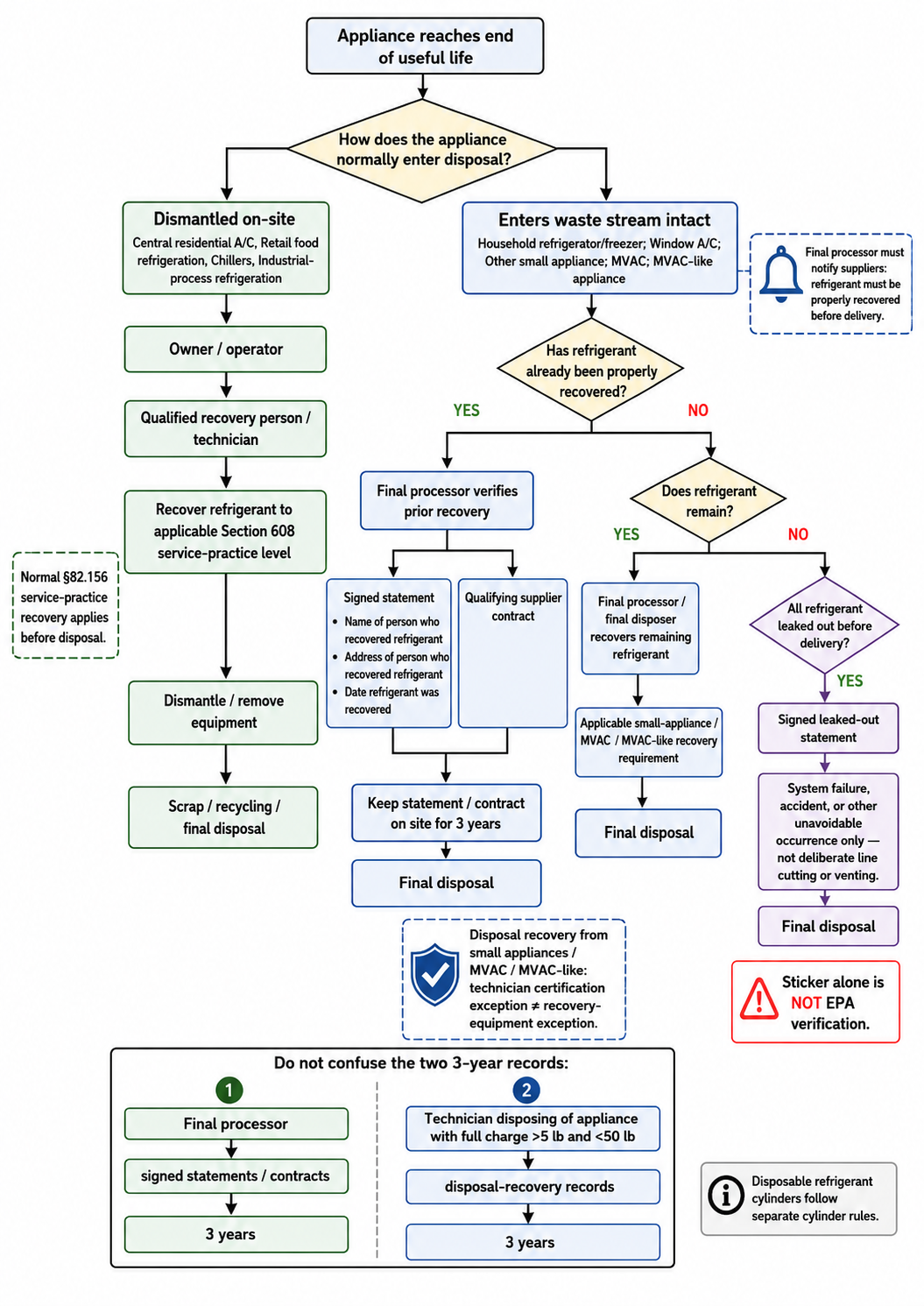
Figure 6.9.1 – Safe-disposal responsibility flow from appliance owner or supplier through refrigerant recovery and final processing.
AI-generated instructional figure: It may contain visual inaccuracies. Use the accompanying lesson text and cited authoritative sources to verify technical and regulatory details.
EPA 608 Exam Focus
What Students Must Remember
The most important disposal distinction is:
Equipment dismantled on-site
→ recover refrigerant under normal service-practice rules before disposal
versus:
Small appliance / MVAC / MVAC-like appliance
entering waste stream intact
→ final processor must ensure refrigerant was recovered
High-Priority Final-Processor Rule
The final processor must either:
recover remaining refrigerant
or:
verify proper prior recovery
Verification Statement
Remember:
Name
+
Address
+
Date
Specifically:
name of person who recovered refrigerant
address of person who recovered refrigerant
date refrigerant was recovered
Sticker Trap
Sticker only
→ NOT sufficient EPA verification
Three-Year Record Trap
Two separate rules use three years:
Final processor
→ signed statements / contracts
→ 3 years
Technician
→ appliance full charge >5 lb and <50 lb
→ disposal-recovery records
→ 3 years
Certification Trap
Small appliance / MVAC / MVAC-like disposal recovery
→ technician certification exception
but:
recovery requirement
→ still applies
and:
recovery equipment
→ must meet applicable performance standard
Leaked-Out Trap
Accident / system failure / unavoidable loss
→ leaked-out statement may apply
Deliberately cut refrigerant line
→ does NOT qualify
Disposable-Cylinder Trap
Under the current rule:
Part 84 disposable-cylinder heel rule
→ exists in current CFR
→ main compliance date January 1, 2028
Do not answer a current-rule question as though the 2028 deadline has already arrived.
Common Mistakes and Confusing Points
Mistake 1: Assuming Disposal Means Refrigerant Can Be Vented
Disposal is specifically one of the activities addressed by refrigerant-management requirements.
Mistake 2: Applying the Final-Processor Statement Rule to a Central Split System Being Dismantled On-Site
A central split system normally follows the service-practice recovery path before field dismantling.
The special final-processor verification framework is aimed at appliances entering the waste stream intact.
Mistake 3: Applying the Main Table 1 Evacuation Values to Small Appliances
Small appliances use their own recovery requirements.
Mistake 4: Applying Small-Appliance Percentages to MVACs
MVACs and MVAC-like appliances have separate requirements.
Mistake 5: Assuming the Final Processor Must Always Recover the Refrigerant Personally
The final processor can verify proper prior recovery using an allowed statement or contract.
Mistake 6: Treating a Sticker as the Required Signed Statement
EPA specifically says a sticker alone is not the required verification.
Mistake 7: Leaving the Recoverer’s Address Off the Statement
The statement requires:
- Name.
- Address.
- Date of recovery.
Mistake 8: Using a Commercial Contract for Every One-Time Homeowner Drop-Off
EPA explains that the contract option is intended for regular commercial suppliers, not infrequent individual suppliers.
Mistake 9: Accepting a Statement Known to Be False
The rule prohibits knowingly accepting, or accepting with reason to know, a false statement or contract.
Mistake 10: Calling Deliberate Venting “Leaked Out”
The leaked-out provision concerns system failures, accidents, or other unavoidable occurrences—not deliberate line cutting.
Mistake 11: Assuming Certification Exemption Means Recovery Exemption
A noncertified person may recover refrigerant from certain appliances for disposal, but the recovery and equipment requirements remain.
Mistake 12: Confusing the Two Three-Year Recordkeeping Rules
Final-processor verification records and technician mid-sized-appliance disposal records are different.
Mistake 13: Treating a Disposable Refrigerant Cylinder as a Small Appliance
A refrigerant supply cylinder is a container, not a refrigeration appliance.
Mistake 14: Refilling a Disposable Refrigerant Cylinder
A one-way/nonrefillable cylinder is not a recovery cylinder.
Mistake 15: Applying the 2028 Part 84 Disposable-Cylinder Rule Before Its Compliance Date
Current regulatory text includes a future compliance date.
Always read the effective date.
Mistake 16: Applying the Future 15 in. Hg Disposable-Cylinder Value to Appliance Recovery
That value belongs to a specific Part 84 cylinder pathway, not to Section 608 appliance evacuation.
Concept-Check Questions
Question 6.9-1
A central residential split system is being permanently removed from a house and dismantled at the job site. Which disposal approach is correct?
A. Cut the refrigerant lines first because the system will be discarded.
B. Recover refrigerant according to the applicable Section 608 service-practice requirements before dismantling the system.
C. Send the charged condensing unit to the landfill and let the landfill decide whether recovery is necessary.
D. Apply a sticker stating “scrap” and vent the charge.
Question 6.9-2
A household refrigerator arrives at the final scrap processor with refrigerant still in the appliance. What must the final processor do?
A. Recover the remaining refrigerant according to the applicable disposal requirements before final disposal.
B. Accept the appliance because refrigerators are exempt from all refrigerant recovery.
C. Cut the tubing outdoors because the appliance is already waste.
D. Apply a sticker stating that the refrigerant probably leaked out.
Question 6.9-3
A refrigerator arrives at the final processor after refrigerant was properly recovered by another person. Which information must the signed verification statement include?
A. Compressor horsepower, voltage, and serial number
B. Refrigerant saturation pressure only
C. Name and address of the person who recovered the refrigerant and the date of recovery
D. Only a sticker stating “refrigerant removed”
Question 6.9-4
Which statement about a sticker on an appliance is correct under current EPA safe-disposal guidance?
A. EPA requires a specific federal disposal sticker for every refrigerator.
B. A sticker by itself is not accepted as the required verification of prior recovery.
C. A sticker eliminates all final-processor records.
D. A sticker is required instead of a signed statement.
Question 6.9-5
A final processor receives a refrigerator with no refrigerant because the refrigeration tubing was deliberately cut by the supplier before delivery. Can the supplier use the “all refrigerant leaked out” exception?
A. Yes, because the appliance contains no refrigerant when delivered.
B. Yes, if the supplier puts a sticker on the appliance.
C. No. Deliberate line cutting does not qualify as an unavoidable leaked-out condition.
D. No, because the leaked-out provision applies only to chillers.
Question 6.9-6
Which statement about Section 608 certification during disposal is most accurate?
A. No person may recover refrigerant from any appliance for disposal without Universal certification.
B. Persons recovering refrigerant from small appliances, MVACs, and MVAC-like appliances for disposal have a technician-certification exception, but applicable recovery requirements and recovery-equipment standards still apply.
C. The certification exception allows intentional venting.
D. The certification exception applies to ordinary repair of every small appliance.
Question 6.9-7
A technician recovers refrigerant for disposal from a stationary appliance with a full charge of 12 lb. What disposal-specific recordkeeping requirement applies under §82.156(a)(3)?
A. No records because the charge is below 50 lb.
B. Keep the required disposal-recovery records for three years.
C. Keep only a sticker on the appliance for one year.
D. Send the records to EPA every month.
Question 6.9-8
Which statement correctly describes the current federal Part 84 rule for disposable refrigerant cylinders?
A. Every disposable cylinder already must be evacuated to 15 in. Hg vacuum under a rule effective in 2020.
B. The current regulation includes disposable-cylinder heel requirements whose main compliance date is January 1, 2028; the future rule must not be confused with current Section 608 appliance-disposal endpoints.
C. Disposable refrigerant cylinders are legally the same as small appliances.
D. All disposable cylinders may be refilled as recovery cylinders until 2028.
Section Summary
Safe disposal follows a chain of responsibility.
The most important first distinction is:
Dismantled on-site
or
enters waste stream intact?
Dismantled On-Site
Examples:
- Central residential A/C.
- Retail food refrigeration.
- Chillers.
- Industrial-process refrigeration.
General sequence:
Recover refrigerant under applicable service-practice requirement
→ verify endpoint
→ dismantle
→ dispose / recycle equipment
Intact Waste-Stream Appliances
Examples:
- Household refrigerator/freezer.
- Window A/C.
- Other small appliances.
- MVACs.
- MVAC-like appliances.
Final processor must:
recover remaining refrigerant
or:
verify prior recovery
→ signed statement or qualifying contract
The signed statement includes:
recoverer's name
+
recoverer's address
+
recovery date
The final processor must:
- Notify suppliers of the refrigerant-recovery requirement.
- Not knowingly accept false verification.
- Obtain a leaked-out statement when an unavoidable prior refrigerant loss makes recovery impossible.
- Keep applicable statements/contracts for three years.
Also remember:
- A sticker alone does not satisfy the current EPA verification requirement.
- Persons recovering refrigerant from small appliances, MVACs, and MVAC-like appliances for disposal have a technician-certification exception, but recovery requirements remain.
- Technicians recovering refrigerant for disposal from appliances with full charges greater than 5 lb and less than 50 lb keep the required disposal records for three years.
- A disposable refrigerant cylinder is not an appliance and must not be refilled as a recovery cylinder.
- Current 40 CFR §84.116 contains a separate disposable-cylinder heel-management requirement with a main compliance date of January 1, 2028.
- Do not mix the future Part 84
15 in. Hg vacuumcylinder value with current Section 608 appliance-recovery requirements.
The next file condenses the complete Module 6 safety, leak detection, shipping, and disposal material into a quick-reference format.
See Section 6.10 - Quick Reference.
References
Current EPA Section 608 Sources
-
U.S. Environmental Protection Agency, Stationary Refrigeration Safe Disposal Requirements, current EPA summary of equipment dismantled on-site, intact waste-stream appliances, final-disposer responsibility, signed statements, contracts, sticker limitations, certification exceptions, and recovery-equipment requirements. Last updated March 23, 2026. Accessed August 10, 2026.
-
U.S. Environmental Protection Agency, Appliance Disposal, current EPA consumer/owner safe-disposal summary. Accessed August 10, 2026.
-
U.S. Environmental Protection Agency, Regulatory Updates: Section 608 Refrigerant Management Regulations, current summary confirming continued applicability of safe disposal, evacuation, certified recovery equipment, technician certification, and reclamation provisions to non-exempt substitutes. Accessed August 10, 2026.
-
U.S. Environmental Protection Agency, EPA’s Refrigerant Management Program: Questions and Answers for Section 608 Certified Technicians, current technician-certification disposal exceptions and disposal-recordkeeping guidance. Accessed August 10, 2026.
-
U.S. Environmental Protection Agency, Recordkeeping and Reporting Requirements for Stationary Refrigeration, current disposal recordkeeping overview. Accessed August 10, 2026.
-
U.S. Environmental Protection Agency, Stationary Refrigeration Service Practice Requirements, current recovery/evacuation requirements used before servicing or disposing of covered appliances. Accessed August 10, 2026.
Current Federal Regulatory Sources
-
Electronic Code of Federal Regulations, 40 CFR §82.155 — Safe Disposal of Appliances, current final-processor, signed-statement, contract, leaked-out statement, supplier-notification, and three-year recordkeeping requirements. Checked August 10, 2026.
-
Electronic Code of Federal Regulations, 40 CFR §82.156 — Proper Evacuation of Refrigerant from Appliances, current recovery levels for appliances, small appliances, MVAC-like appliances, and MVACs; disposal recordkeeping for appliances with full charge greater than 5 lb and less than 50 lb. Checked August 10, 2026.
-
Electronic Code of Federal Regulations, 40 CFR §82.158 — Standards for Recovery and/or Recycling Equipment, current recovery-equipment standards applicable to service and disposal recovery. Checked August 10, 2026.
-
Electronic Code of Federal Regulations, 40 CFR §82.152 — Definitions, current definitions including technician, small appliance, MVAC-like appliance, and other terms used in the disposal framework. Checked August 10, 2026.
Current AIM Act / Disposable-Cylinder Sources
-
Electronic Code of Federal Regulations, 40 CFR §84.116 — Requirements for Disposable Cylinders, current regulatory text establishing requirements beginning January 1, 2028 for qualifying disposable cylinders containing regulated substances, including heel removal, alternative certified-technician evacuation to 15 in. Hg vacuum, certification statements, and three-year final-processor records. Checked August 10, 2026.
-
U.S. Environmental Protection Agency, Management of HFCs and Substitutes — Regulatory Impact Analysis Addendum, current rulemaking support describing refrigerant heel recovery from disposable cylinders. Used only as background to the codified Part 84 requirement.
Current DOT Cylinder Source
- Electronic Code of Federal Regulations, 49 CFR §178.65 — Specification 39 Non-Reusable (Non-Refillable) Cylinders, current DOT specification identifying DOT-39 cylinders as non-reusable/nonrefillable. Checked August 10, 2026.